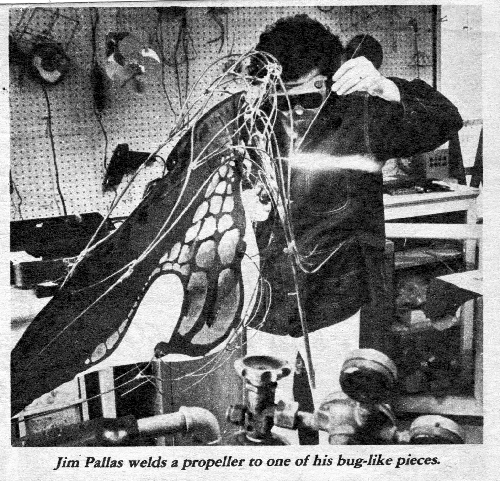
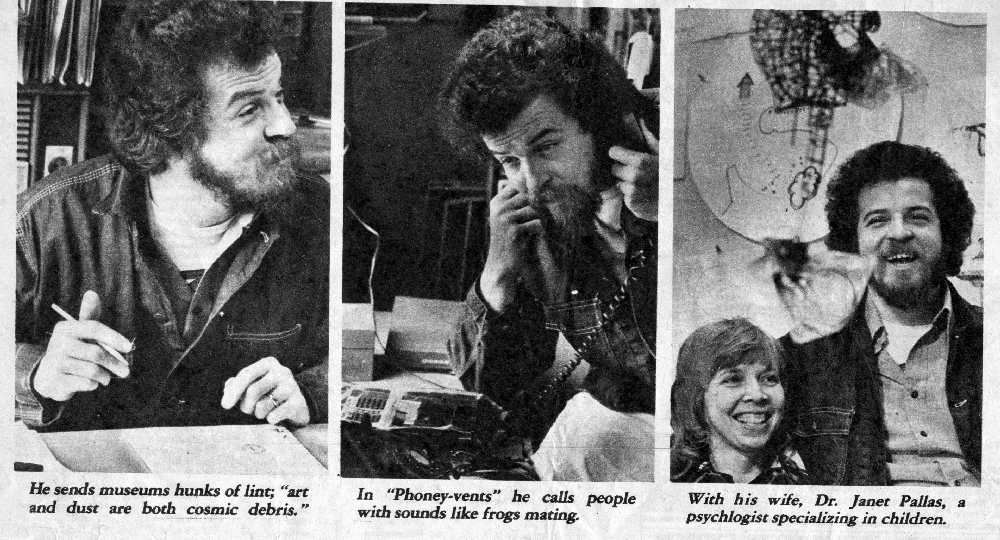
| To artist Jim Pallas, Ma Bell and the U.S. mail are channels for trans- mitting ironies, insights and a special kind of craziness that knocks his audi- ence off dead center. He keeps a little black book for his phone events (spelled "phoney-vents") and treats the people on his list to a smorgasbord of recorded sounds rang- ing from frogs mating to Captain Ahab spouting "Moby Dick," from astro- nauts talking on the moon to time sig- nals interspersed with harmonica music. Pallas' mail events carried by unsuspecting postal employes might contain a sheet of gray fleece with an elaborately sealed and stamped docu- ment certifying that " the enclosed is, in fact, Michigan lint." Or an IBM punch card saying: "Your deviant acts have been detected and noted in our banks—warning 1 M8S6." |
Like other U.S. and
Canadian artists involved with moving systems of infor- mation, Pallas regards his mail and phone activity as concrete poetry based on immediate experience. Important? Yes. But strictly as a sideline to his main event—cybernetic sculpture that lights up, listens, counts and moves in response to such stimuli as the wind, the human voice and Mrs. Carl Levin's harpsichord. But all this is getting ahead of who Jim Pallas is, what he actually does. how he thinks and where he fits into the present art scheme. At first the picture seems conven- tional enough. Native Detroiter. Married. The father of a son, 11, and a daughter, eight. Lives in a comfortable brick house in Grosse Pointe Park and works in a reconverted garage studio. |
He earned two art degrees from Wayne State University and has been teaching an for 10 years at Macomb Community College. He has exhibited his work in such places as the Detroit Institute of Arts; the Flint museum and the Detroit Artists Market. At this point the portrait of indige- nous artist-teacher and devoted family man shifts into another perspective. His wife is Dr. Janet Pallas, a prac- ticing psychologist specializing in chil- dren. Their outwardly traditional home displays an eccentric collection of early American quilts, Indian bead- work and Pallas' own zany machines operated electronically or spelling out such messages as "pockketa, pockketa" and "zap." Out back a "garden" of wind-driven propellers operate sculptures inside the house. The dog house is embla- |
| zoned with a "Go Navy" sticker
and the first view of the studio ("where I play my electronic games") is through a wide-angle lense glued to the door glass. Studio contents suggest the presence of a latter-day Rube Goldberg. Funny, yet oddly beautiful wire structures hanging everywhere . . . scattered electronic components . . . welding equipment . . . plastic drawers filled with clamps, clips, brass washers, bearings, swivels, fuses and other in- gredients for future Pallas sculptures. . . telephone, tape recorder and black book for the phoney-vents." Pallas, the poet, operates from a desk strewn with rubber stamps made up for his mail art. Some favorites are "Non-self relating" . . . "This is not art"... "Verisimiltude"... "Magni- tude Of Lasting Significance" . . . "Indexed Clarity." |
About concrete poetry Pallas says: "Marcel Duchamp broke the egg and guys like me are making omelettes." Like Dada artist Duchamp, who once drew a moustache on a reproduc- tion of the Mona Lisa and exhibited a urinal signed "Mutt," Pallas has an irreverence for the sanctities of art and the games people play in produc- ing, exhibiting and selling it "Art as a concept is dead," Pallas says. "You can't take what we believe about art—that it is a semi-literary ac- tivity—any farther back than the Re- naissance. In all healthy societies, art and religion and science are inseparable. I believe we're headed in that direction again." With a quick laugh and an apology for "talking heavy," Pallas launches into the current art scene: |
ON PRINTMAKING: "I don't like all that mystique of turning out signed prints in numbered editions. I can do the same thing faster with dime-store tec "All I have to do with a print is make it, sign it and stamp it "this is art'. Or not sign it and stamp it 'this is not art'. No problem." ON MUSEUMS: "Once I decided that art and dust are both cosmic de- bris, I began sending Michigan lint to museums for their permanent collec- tions. Properly certified using my rubber stamps, of course." ON ART DEALERS: "They always demand documentation. I send a De- troit dealer a crushed Pepsi Cola can from Lake Odessa. It was all dated and certified. I offered him the piece for $40. But I never heard from him again. |
| ON GALLERIES: "They can't mer- chandise my sculpture, can't stick it on a shelf or on a pedestal. A gallery exhibit is a nice ego trip. But I want to get my work out to people on a one-to- one basis " ON COMMISSIONS: "When I accept a commission (that's a heavy word), I find out about the site, the people, why they want the piece and how they con- ceive of it working. Then I tell them they can call the job off at any given point and I'll return their money. That leaves me completely free." DETROITERS who own Pallas sculptures are not the usual breed of art patron. Two recent commissions were done for Detroit City Council President Carl Levin and his wife, Barbara, and for Recorder's Court Judge Michael J. Connor and his wife, Marilyn. The Levin piece, called "J.P.P.F.B.L." (for "Jim Pallas Plays for Barbara Levin"), is a tribute to the harpsichord that Mrs. Levin built from |
a
do-it-yourself kit. Pallas says he set out to represent visually the linear, se- quential structure of harpsichord music. He calls the sculpture "a funny organism that fits into the family rou- tine." A microphone sits on the harpsi- chord and elaborate electronic cir- cuitry causes the piece to move and flash while Mrs. Levin plays. "I got in over my head with the electronics for this one," Pallas says. "So I went to an engineer friend for help. He threw out my circuitry and started over. Now we have a partner- ship that leaves me free to concentrate on the visual and behavorial side of the work." Barbara Levin's harpsichord turned out to be less demanding than the Con- nors' Williamsburg house, an authentic restoration built originally by folk poet Edgar A. Guest. "Symmetry is the name of the game in this traditional setting," says Pallas. "The piece was-a challenge be- cause it not only had to be compatible |
with the house but hang
over the fire- place in the honored spot reserved for ancestor portraits." In an earlier time the Connor sculp- ture would have been attributed to witchcraft. Even today it's hard to be sure that the flashing lights responding to voices in the room and to shifts in the wind outside are not some form of sorcery. Pallas explains that two propellors outdoors are connected to the red light. which provides the data. and to the green light, which responds to the shift. Five solenoids act as muscles to produce motion when they contact with the signal. "I like to make inputs so they are the real thing," he says. "If the wind stayed the same you could predict what the sculpture would do. It's a lot more loveable, though, when you just look at it and forget how it works." The Connor boys, aged 6 and 4, have the right idea. They call the sculpture "Wizard" and consider it a fifth mem- ber of the family. |
| Does the artist see his
work in human terms? "No," Pallas says. "From a mechanical-functional viewpoint, the sculptures are more like insects which have a sensory system geared differ- ently than ours. "Bugs have a whole other range of light and sound. They get a different sense of data and consequently have another notion of reality than humans do. I deal with parallels and allegories rather than organisms." Pallas arrived at cybernetic sculp- ture, which he describes as "a system of process and change," by an un- marked route. He was never a modeler, a caster or a pedestal man. |
He wanted action, and he
got it by put- ting his sculpture on wheels 13 years ago before he graduated from Wayne State. He worked gradually into kinetic pieces, which plugged into. the wall and moved. "I assigned myself the prob- lem of designing movement like a choreographer. It was formal, disci- plined stuff, but limited. "Once I set a pattern, the sculpture simply repeated itself. I wanted to go on to more ambitious pieces with unpredictable responses." After he began using wind changes as a stimulus for his sculpture, Pallas bought 60 acres of land near Hastings, 126 miles west of Detroit. |
He built a straw vacation house
for his family and is using the land as a laboratory for his work. "I put up chintzy pieces using stuff from the local dump. The idea is to test wind variables by seeing how long a piece will stand before it gets blown away." Jim Pallas is a Detroit original with the tinkering genius of Henry Ford I combined with the ironic wit of Marcel Duchamp. What he does, he says, re- sults from trying to figure out what a grown man is trying to prove by play- ing electronic games. Detroit News Magazine June 8, 1975 |