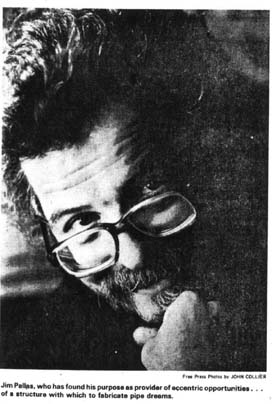
By MARSHA MIRO Free Press Art Writer - Jim Pallas tried being an administrator ~ he worked at the Michigan Council for the Arts its first year. helping dole out a $6,000 budget. And he even tried community activism, in ^GS. as a member of the North End Steering Commuee in Highland Park charged with flush|ng out commu- nity hostilities. But what Jim Pallas Jhas always done best, where he belongs, is making art. "Art is much more personal, more absurd," says the 39-year-old Detroiter. "Those other things, you can give good societal reasons for be- ing in. But art has none of those. It always stays absurd. It admits to no greater meaning." "I do it because I enjoy it. because I want to, be- cause it feels good, because it is interesting, be- cause it is expressing something I am fascinated with and do not know how or why." PALLAS IS NOW doing a model for the contro- versial electronic sculpture set to hook into the carnival atmosphere of the new Washington Bou- levard downtown sometime this spring. His "Cen- tury of Light" is an umbrella of 140 lights linked by red pipe, set in a circuitry configuration. The lights will be activated in sequences by spectator movement and talk. |
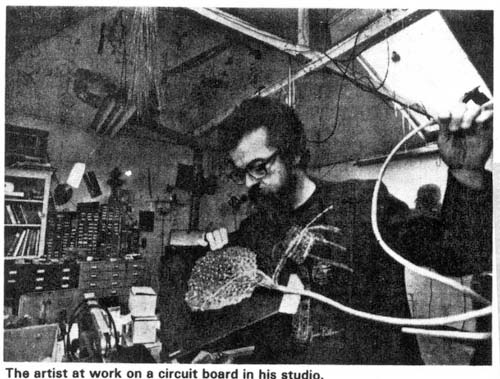
He hopes to add an indestructible compy.er terminal — if the city accepts the sculpture from the private donors who commissionedpiece — so viewers can type in their own light-pattern vari- ations. Contact will be made by a repeated mes- sage of "Hello, hello, hello" on the keyboard screen as the computer searches out a program- mer, or as it communicates with whoever wants a bit of data on its creation and presence. It will make us all makers of and participators in art. Absurd. Eccentric. Wacky. Absolutely. But that very eccentricity gives vent to some of our most prophetic creations. It's not Pallas' way of being trendy, or nurturing the arty-nut in us but rathsr his commitment to anti-patness, to the ex- ceptions in any system and the spirit of satire and play that is often their precipitator. His art. which has used electronics in other imaginative ways over the years, promises no spiritual elevation. It promises only a creative ex- perience for those willing to try. If anything, he has found his purpose as provider of eccentric op- portunities, provider of a structure with which to fabricate pipe dreams. PALLAS, HIS WIFE, who is a child psycholo- gist, and their two children live in a Grosse Pointe Park house which overflows with his art, as well as objects that usually accrue to artists from other artists and from an insatiable interest in things vi- sual. His studio — the garage — is a jumble of |
materials and chaotic remains of
old sculpture. It seems the place of an absentminded professor who is also a pre-occupied inventor. One wall is full of little drawers containing rubber stamps, which Pallas calls his impulse buys. He just received a heart — to him, a symbol for "heart throb" — that quickly joined the jumble of such other wonderful messages as "Chaos," "fine art," "aesthetic content," and "terrific." He wiil gladly stamp anything you want with "work of art" — another wry gesture against meaning- less labels. An acquaintance might receive a Pallas ID card in the mail -bearing word of his election to the ranks of "artistic potential" conferred by his non- profit organization — The Detroit Art Works — or a duplicate of Pallas' old high-school ID stamped "void." "Everyone should have the right to void certain segments of their past," he ex- plains. PALLAS FOUNDED the Detroit Art Works to channel grant money to individual artists. "Any- one who does anything that has to do with art in Detroit is an unwitting member of Detroit Art Works. It is an anti-exclusive club. Really, it is a concept to use to realize other projects, a free or- ganization. Gall up and use it if you need a creden- tial for your biography!" Pallas began a series of phone events through |
| DAW in 1978. Anyone could call
his attic tele- phone and hear unedited tapes by Detroit artists, which were meant &s works of art themselves. Pallas himself began the se- ries in May '78 with a tape of Michigan noises, and the project has continued, sporadically, so far drawing 131,000 calls. This month, internationally known artist Ken Friedman has done a different recording for each day. Wednesday's, for ex- ample, was called "An Unfinished Symphony," an art work in words. Call 881-2345 anytime for the day's message. Pallas ex- plains: "For the price of a phone call, anyone can 'collect' Fried- man's art." As you might have suspected. Pallas "learned to read on comic books." He collects no-holds-barred "Underground Comics," the more outrageous the better. "They are the dum- best, most disgusting, sexiest and grossest comics produced. I enjoy them because they push freedom of expression in that media to the limit." Wayne State University turned out to be just the place for someone of Pallas' bent. He received a BFA, then an MFA in 1953 from the art department. "They left me alone. There were enough teachers who didn't want to shape me. I didn't like the artifical campus life of Eastern or Michigan State. Wayne had an incredible mix of people. The old black lady who wore tennis shoes and carried a shopping bag finally graduated. She was a real primitive paint- er. There was always someone in advertising too» who was tired of drawing mayonnaise jars and wanted to get back to the nude. Plus ail the crazies in-between." Since leaving Wayne State, he has been a full-time an teacher at Macomb Community College. |
PALLAS GOT ON his current art
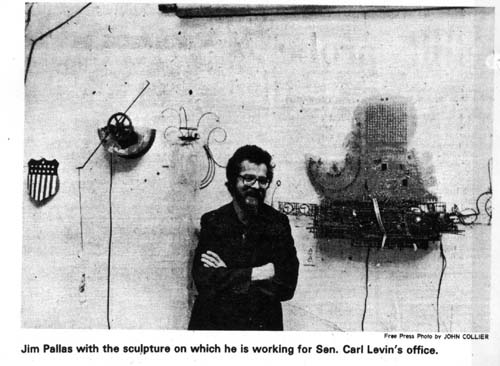
track in 1964 when he be- gan making little objects ~ hybrid cars or slices of the moon, funny things which had cartoon clouds overhead painted with cliche action words nke"zoom," "zap," "click" and "puff- puff." From there, it was a fast step to making funky objects that actually worked. So the moon zoomed. But Palias found he "was more interested in the switches that govern behavior — a sound, light or action — than a sim- ple programmed behavior." Computer technology, which took him 10 years to master, offered the tools to establish a reper- toire of complex activities in his creations. Unlike most computer artists who use the mechanism to produce pictures, Pallas treats the circuits and wires them- selves as drawings. In the works he's completed these last eight years, activities by spectators or nature cue in light and noises. The responses are not signals of data being collected — the computer's usual function — but compelling activities meant to be looked at aside from any factual meaning. Pallas is adding the mystical to the machine. Such computer works have been exhibited in a prestigious New York art gallery and in numerous major shov/s in the De- troit area. In 1978 he filled the north court of the Detroit Insti- tute of Arts with 20-foot-high plastic bags which randomly in- flated and deflated. He called the work "TubeDance." FOR THE LAST eight months, he has been v/orking on a commission for U.S. Sen. Carl Levin's Washington office. The main portion of that sculpture has an austere, government-type building drawn at the top from silver circuits. Below it, a floor plan of the Senate meant to have an overlay labeling the sena- tors' desks is set to light when signaled by transmissions of |
microphoned voices in the chamber. Pallas
also sees the seating
chart as a way for Levin to keep track of his colleagues' pro-
gress in the Senate hierachy.
The scales of justice protrude from one side of the piece —
their creaky, erratic motion generated out of a complicated se-
ries of elaborate metal tubes. A second section consists of a
moving wheel with a long arm holding a dollar that swings up.
then sweeps precipitously down in a dramatic fall. A third part
will have rocks Levin brought from Israel echoing a respect for
religious values and probably a bull's fresh donation, flown in
from Texas, satiriziog a more political penchant.
Says Pallas of this work: "I didn't want to do a negative
piece that would hinder Levin's relation to the public. But
poltics are brutal. They bring hope, but are corny. Fame fades
power corrupts, money is behind it all and death behind that.
chart as a way for Levin to keep track of his colleagues' pro-
gress in the Senate hierachy.
The scales of justice protrude from one side of the piece —
their creaky, erratic motion generated out of a complicated se-
ries of elaborate metal tubes. A second section consists of a
moving wheel with a long arm holding a dollar that swings up.
then sweeps precipitously down in a dramatic fall. A third part
will have rocks Levin brought from Israel echoing a respect for
religious values and probably a bull's fresh donation, flown in
from Texas, satiriziog a more political penchant.
Says Pallas of this work: "I didn't want to do a negative
piece that would hinder Levin's relation to the public. But
poltics are brutal. They bring hope, but are corny. Fame fades
power corrupts, money is behind it all and death behind that.